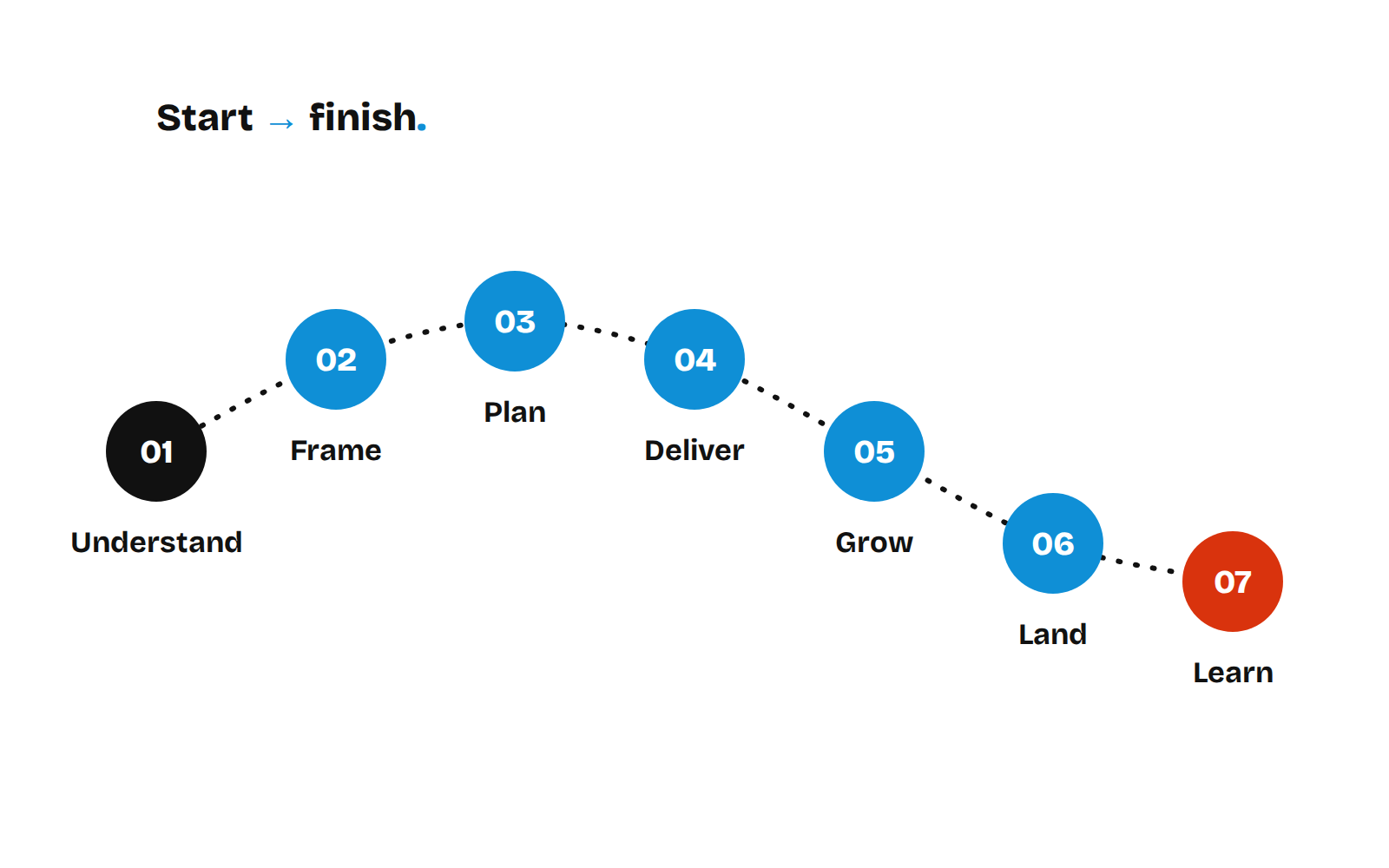
Planning: pick your trade-offs, then take small steps
There's no free lunch. Quality, speed and cost are always in tension, and the saying goes that you can have two but never all three. The real skill, as this piece argues, is delivering the best combination of the three for the situation at hand, not surrendering to the trade-off.
For the plan itself, I lean on the lessons of How Big Things Get Done. Know where you're going: think slow, act fast. Plan with ferocious rigor and learn from analogous projects. Follow the Lego principle, turning one big undertaking into many small, repeatable ones. And watch out for the pull of sunk costs; fail fast when the evidence says so.
Throughout, I think global and act local. I keep the long-term picture in view and explain it, while taking care of today's needs, and I ask whether what we're doing now will still scale in a couple of years.
Execution: be reliable, and be honest about progress
Trust is built by delivering on time, every time. If that means reshaping the scope with stakeholders so we keep moving, I'll do it. If a delay is coming, I flag it early.
I'd rather deliver a partial answer than no answer; progress beats perfection. I'm an optimistic realist: I won't oversell what something can do, but I'll advocate for moving ahead under uncertainty. People handle that uncertainty differently, so I share real information as soon as I have it with those who need it to plan. I don't feed rumors, particularly with people who would use them to serve themselves or unsettle others.
Innovation needs friction. I want team members to feel free to challenge one another, and me, when the team gains from it. For that to be credible, I have to change my mind openly when I'm wrong.
With stakeholders, I ask the team to see things from their side, never to assume bad intent before hearing their reasons, and to look for middle ground that moves things forward. A good negotiation leaves both sides better off, not both a little worse.
Throughout: the people doing the work
A technical leader can't lead work they don't understand. I make a deliberate effort to learn my team's work. That's what lets me set realistic expectations on scope, timeline and capability, and what earns their trust. When results disappoint, it helps me see why and steer the team back on track.
That understanding comes from real curiosity: time spent on workflows and assumptions, and questions asked to understand rather than to catch someone out or show what I know. It also takes enough vulnerability to show my weaknesses as well as my strengths.
I want to know what gets each person to work every morning, because growth means different things to different people. With that understood, I push: stretch targets, especially for development, and every growth opportunity I can reasonably offer, adjusted if the stretch becomes too much. I respect those who are content where they are, as long as they're performing. For those who aren't, a lateral move can sometimes be the right call for everyone.
I don't manage to the average. How I handle the extremes, the strongest and the weakest performers, says more about me as a manager than anything else. Most of my energy goes into growing the strengths of the best and containing the weaknesses of the weakest before they become a liability.
Feedback is timely and specific, positive and negative alike. For serious concerns, I gather several data points and perspectives before concluding, but I don't sit and wait for a change that isn't coming.
The best work multiplies other people's impact. I hold back from doing things myself when someone else would learn from doing them, and I'm there when they want advice. And I stay one step closer to my team than to my manager: advocating for them, removing distractions and pushing back upward when needed.
Landing it: make it clear, make it stick
How a project lands matters as much as how it's run. I believe in stories that connect with their audience, adapted to the moment: simplified for some, anchored in shared experience for others, detailed when the details matter.
Aesthetics count, even in engineering. A well-crafted deck, a polished report or an intuitive dashboard gets embraced far more readily than raw words and numbers, as long as the content is sound and accurate. It also sets your work, and your personal brand, apart.
Finally, I want whatever we built to be repeatable. Reaching a goal without a process can't be transferred, while imposing a rigid, off-the-shelf process kills creativity and adoption. Flexible processes, built around shared goals, are the answer.
After the project: keep learning the craft
Leadership is a craft, so I keep working at it through reading, training and trying new approaches. Among the people who've influenced me most: Tom Hunsaker, Francesca Gino, Daniel Kahneman and Simon Sinek.
Further reading: the “design squiggle” by Damien Newman captures the same idea beautifully at thedesignsquiggle.com.